
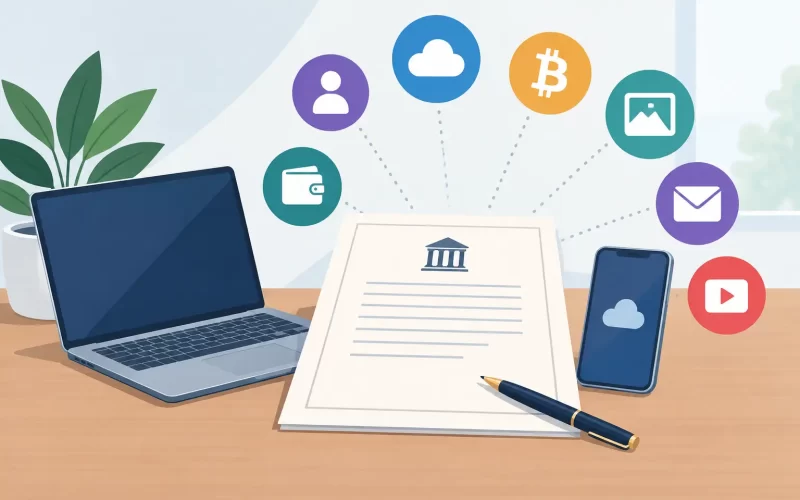
A mobile phone can hold far more of your life than a filing cabinet once did: family photographs, banking apps, email, investment accounts, a side business and perhaps cryptocurrency. Yet these things are easily missed when making a will. Including digital assets in a will helps your executors understand what exists, who should receive it and how your digital life should be handled after you die.
This does not mean putting every password into your will. A will may become available to people who do not need access to your accounts, and passwords can change regularly. The sensible approach is to make clear instructions in your will, supported by a separate, securely stored record that your executors can find when the time comes.
What counts as a digital asset?
A digital asset is anything you own, control or have a valuable interest in online or electronically. Some have a clear financial value. Others may have little sale value but are deeply personal, such as a library of family photographs or messages saved in an account.
Common examples include online bank and savings accounts, investment platforms, cryptocurrency and non-fungible tokens, digital wallets, online businesses, websites and domain names, monetised social media accounts, digital music or film libraries, cloud storage, emails and loyalty points. You may also own intellectual property held digitally, such as photographs, books, designs, software, online course materials or content that earns advertising income.
Not every account can simply be passed on like money in a bank account. Many services grant you a personal licence to use their platform or content. Their terms may say that an account closes on death, or that purchased digital films, games or music cannot be transferred to someone else. This is why it helps to distinguish between an asset you own and an account you merely use.
Why digital assets need a place in your will
Without instructions, your family may not know which accounts exist or whether there is money held in them. They may continue paying subscriptions they cannot cancel, lose access to valuable business records, or struggle to retrieve irreplaceable photos.
For cryptocurrency, the risk can be even greater. There is no bank manager who can reset a lost private key. If nobody can locate the wallet, recovery phrase or clear instructions, the value may be lost permanently. Equally, handing over a recovery phrase too casually can put the asset at risk during your lifetime.
A will also gives you the chance to make personal choices. You may want a particular person to receive your camera archive, website or digital business. You may prefer your social media accounts to be deleted rather than maintained as memorial pages. Your executors can deal with the estate, but clear wishes make a difficult job much easier.
How to include digital assets in a will
Your will does not need to list every email address or subscription. In fact, a long and detailed list can quickly become out of date. Instead, it should give your executors authority to deal with your digital assets and explain any specific gifts or wishes that matter to you.
For example, you might leave a valuable online business, domain name or cryptocurrency holding to a named beneficiary. The rest of your digital property can form part of your residuary estate – everything left after debts, expenses and specific gifts have been dealt with.
Where an account has sentimental rather than financial value, you can include a letter of wishes. This is a separate document that guides your executors but is usually easier to update than the will itself. You might say who should receive your photo archive, whether emails should be retained, or whether you would like an online profile removed.
A letter of wishes is useful, but it does not replace a properly made will. If you want to make a legally binding gift, it needs to be expressed correctly in the will.
Choose executors who can cope with the task
An executor does not need to be a technology expert. However, they should be organised, trustworthy and comfortable asking providers for help where needed. If your estate includes a digital business, substantial cryptocurrency or valuable intellectual property, consider whether your chosen executor has the right skills or whether professional advice may be needed.
You can appoint more than one executor. One may be well placed to manage the general estate, while another understands a particular business or asset. Think carefully before sharing sensitive credentials, though. An executor’s role begins when you die, not while you are alive.
Keep an asset record, but keep it secure
The most practical step is to prepare a separate digital asset record. This should tell your executors what exists and where to find the information they need, without turning your will into a security risk.
Your record could include:
- the name of each important account, wallet, website or platform;
- the email address or username connected to it;
- a brief note of its value or purpose;
- where passwords, recovery codes or private keys are stored; and
- any instructions for closing, preserving or transferring the account.
Do not write passwords, PINs or private keys in your will. It is also unwise to keep them in an unprotected note on your mobile phone or in an email inbox. A reputable password manager, encrypted storage or a carefully secured paper record may be appropriate, depending on your circumstances. The key point is that your executors must know that the record exists and how to access it lawfully when required.
Review this record regularly. A new phone, changed password, closed investment account or forgotten crypto wallet can make old instructions useless. Updating the separate record is much simpler than rewriting your will each time you change a login.
Be realistic about account access
Your executors should not assume they can simply use your login details after your death. Providers have their own rules, and some will require proof of death, a grant of probate or other documents before they will release information or close an account. Using someone else’s account in the wrong way can breach terms and create avoidable problems.
Instead, your executors should contact the provider and follow its bereavement process. The access information you leave behind helps them identify the account and understand its importance. It does not override the provider’s terms or the law.
This is particularly relevant for social media, email and cloud storage. Some providers allow memorialisation, download of certain content or closure on production of documents. Others offer very limited access. If preserving photographs or work files matters to you, consider keeping a copy in a place your family can lawfully reach rather than relying on a single online account.
Cryptocurrency needs extra care
Cryptocurrency is not automatically inaccessible after death, but it demands preparation. Your will should identify that cryptocurrency exists and state who is to receive it. Your separate record should explain the type of wallet used and where the recovery information is stored.
Never include a seed phrase or private key in the will itself. Anyone with that information can potentially control the funds. You should also avoid telling beneficiaries the details too early if that would compromise your security.
If the value is significant, specialist legal and tax advice can be worthwhile. Cryptocurrency can fluctuate sharply, may be held across several platforms and can raise difficult questions around valuation and administration. A simple will can still form the foundation, but complex holdings deserve more careful planning.
Use your mobile phone to start organising
Estate planning is often delayed because people think they need a perfect folder, a free afternoon and every answer at once. You do not. Start by noting the accounts and assets your family would struggle to find without you.
If you prefer to begin on your mobile phone, the Will Do app, available for Apple and Android devices, can help you organise the details and decisions you need to consider before making your will. Treat any app-based notes as preparation, not as a replacement for a validly signed and witnessed will.
For a will to be valid in England and Wales, it must meet formal signing and witnessing requirements. In most ordinary cases, it must be signed by you in the presence of two witnesses, who then sign in your presence. A beneficiary, or the spouse or civil partner of a beneficiary, should not act as a witness because this can affect their gift.
Review your will when your digital life changes
A will should reflect the life you have now, not the life you had five years ago. Review it after major events such as marriage, divorce, buying a home, having children, starting a business or receiving an inheritance. Digital changes matter too: a growing online business, a new investment platform or a substantial cryptocurrency holding may justify an update.
Your family should not have to guess what matters to you, search through old devices or wonder whether an online account holds value. A clear will, sensible digital records and secure storage give them a practical route forward when they need it most.