
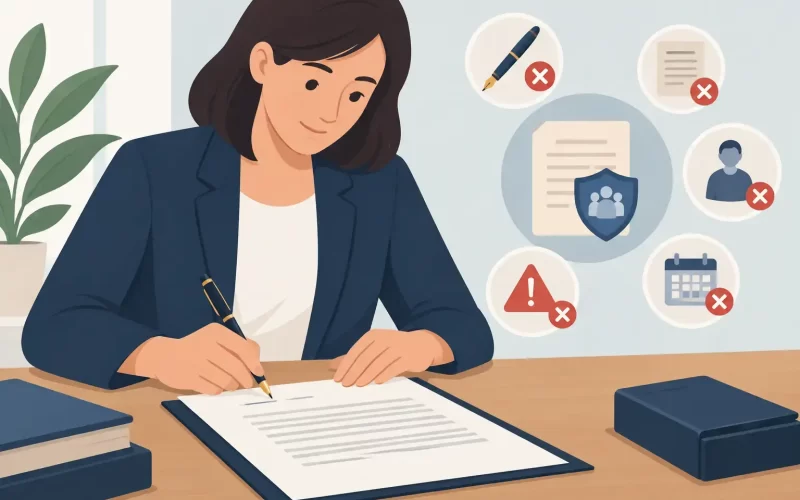
A will can be carefully written, clear about who should inherit and still cause serious problems if it is not signed correctly. The most common mistakes when signing wills are often made in a hurry at the very last stage – sometimes at a kitchen table with well-meaning family members nearby. A few minutes of care can help ensure your wishes are legally effective when they are needed.
For a standard will in England and Wales, signing is not simply an administrative detail. It is part of what makes the document valid. If the rules are not followed, the will may be challenged or rejected, leaving your estate to be dealt with under intestacy rules instead.
1. Using a beneficiary as a witness
This is one of the most costly mistakes. A beneficiary is someone who is due to receive money, property or possessions under your will. They should not witness it. Nor should the husband, wife or civil partner of a beneficiary.
If a beneficiary or their spouse or civil partner acts as a witness, the will itself may still be valid, but the gift to that person can fail. That could mean a loved one loses an inheritance you fully intended them to have.
Choose two independent witnesses instead. They should be adults who are not named in the will and are not married to, or in a civil partnership with, anyone who is named to benefit. Neighbours, friends or colleagues can often be suitable choices, provided they understand what they are being asked to do.
2. Signing without both witnesses present
Your signature must be made or acknowledged in the presence of two witnesses who are present at the same time. Each witness must then sign the will in your presence.
This does not mean one person can sign in the morning and another can pop round later. It also does not mean your witnesses can sign while you are elsewhere in the house. Everyone should be together, able to see the signing take place.
The process is straightforward: you sign the will, or confirm that a signature already on it is yours, while both witnesses watch. Then each witness signs while you remain present. It may feel formal, but this simple procedure protects everyone involved.
What your witnesses need to know
A witness does not need to read your will or know what it says. They are witnessing your signature, not approving its contents. They should, however, understand that they are witnessing a will and be willing to provide evidence if its signing is ever questioned.
3. Forgetting to sign every required place
A professionally prepared will should make clear where you need to sign and where witnesses should add their details. Follow those instructions precisely. Do not assume that one signature somewhere on the document is enough if a signing page has been provided.
Use the same version throughout the process. Before anyone signs, check that all pages are present, that there are no blank pages where wording should be, and that it is the final document rather than an earlier draft. It is sensible for everyone to remain together until the witnessing is complete.
Witnesses should write their full names, addresses and occupations clearly where requested. This can make them easier to trace many years later if confirmation is ever needed.
4. Making handwritten changes after signing
Perhaps you remember a further item you want to leave to someone, notice an old address or decide to change an executor. It can be tempting to cross out a line and add a note in the margin. Do not do it.
Changes made after the will has been signed can create uncertainty. An alteration may not take effect unless it is properly witnessed, and it can raise questions about when it was made and whether it reflected your final wishes.
For a small change, a properly prepared codicil may be suitable. For more substantial changes – such as changing beneficiaries, guardians or the way your home passes on death – making a new will is usually clearer. The right option depends on what has changed, so do not rely on an informal amendment.
5. Letting someone pressure you into signing
A will should reflect your own decisions. Family members can offer support, but they should not dictate who receives what or pressure you to sign something you do not understand.
Undue influence is a serious concern, particularly where an older or unwell person is dependent on someone who stands to benefit. Arguments are more likely if the main beneficiary arranged the will, was present throughout discussions and signing, or kept others away.
If you think someone may question your choices, take practical steps. Discuss your wishes independently, make sure the will is clearly explained to you, and use witnesses who are genuinely independent. A short written record of your reasons can also be helpful, especially if you are leaving less to a close relative than they might expect.
6. Signing when you do not understand the document
You should never sign a will you have not read or had explained to you. Check the names of executors and beneficiaries, the gifts you have made, and what happens to the remainder of your estate. A spelling error may be fixable, but a wrong name, outdated address or unclear gift can cause avoidable delay.
Pay particular attention to your home. If you own it jointly, the type of ownership matters. Joint tenants and tenants in common are treated differently on death. If you want your share of a property to pass into a trust, perhaps to protect it for children while allowing a partner to remain living there, the will and ownership arrangement need to work together.
Protective Property Trusts and Flexible Life Interest Trusts can be useful in the right circumstances, but they are not a one-size-fits-all answer. They may offer protection where there are children from a previous relationship, concerns about remarriage or a wish to preserve a share of the home. They also bring responsibilities for trustees, so they need to be considered carefully before signing.
7. Assuming marriage, divorce or separation changes everything
Life changes can affect a will in ways people do not expect. Marriage or civil partnership usually revokes an existing will unless it was made in contemplation of that particular marriage or civil partnership. If you marry after signing, an old will may no longer do what you intended.
Divorce does not automatically cancel the whole will. In broad terms, it usually treats a former spouse or civil partner as though they had died before you, but the rest of the will remains in place. Separation alone does not change a will at all.
This matters for cohabiting couples too. Living together does not give a partner the same inheritance rights as marriage or civil partnership. If your relationship changes, review your will promptly rather than assuming the law will reflect your wishes.
8. Leaving the original somewhere nobody can find
The original signed will is the key document. A photocopy, scan or photograph may be useful for reference, but it is not normally a substitute for the original when your estate is administered.
Keep the original somewhere safe, dry and accessible. Tell your executors where it is stored and make sure they can obtain it when needed. Avoid storing it loose among household paperwork where it might be discarded during a clear-out, damaged by damp or mistaken for an outdated draft.
If you use a will storage service, keep the storage details with your important records and let your executors know. Good storage is not glamorous, but it is part of making sure your planning actually works.
9. Putting off the signing altogether
An unsigned will has no legal effect. A document saved on a laptop, printed in a drawer or discussed with your family is not enough. Until it has been properly signed and witnessed, your estate may still be distributed under the intestacy rules.
Once you have made your decisions, arrange a time with suitable witnesses and complete the process without unnecessary delay. If you need a straightforward route through the choices involved, English Wills provides plain-English guidance designed to help households put a valid plan in place.
Your will is there to make a difficult time less uncertain for the people you care about. Sign it carefully, store it safely, and review it whenever life takes a meaningful turn.