
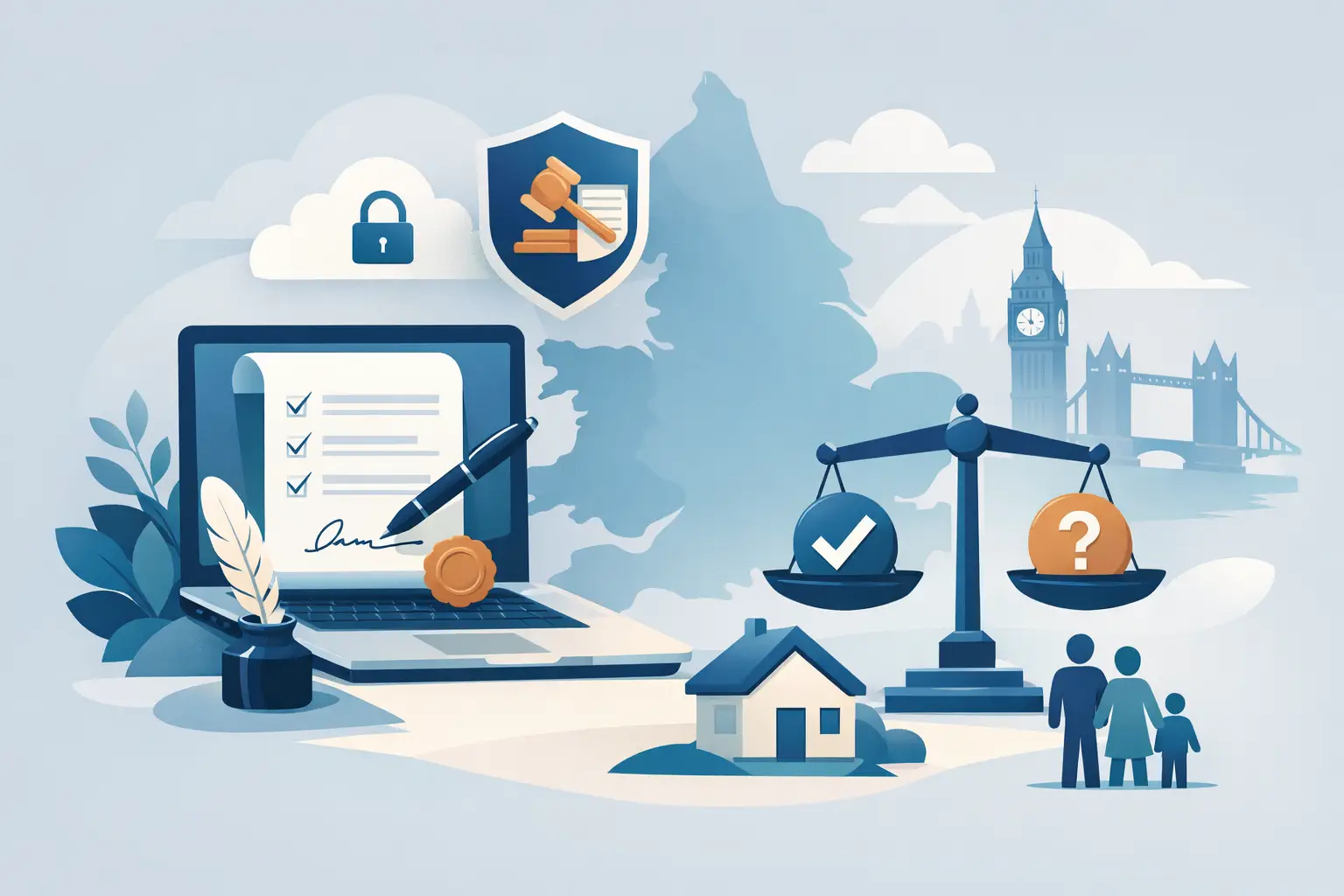
The moment that decides whether an online will work is not when you press ‘pay’ or complete a questionnaire. It is when the finished document is properly signed and witnessed. Get that final step right and an online will can carry the same legal weight as one prepared in a solicitor’s office. Get it wrong and your family may be left dealing with delay, expense and uncertainty at an already difficult time.
Are online wills legal in England?
Yes. Online wills are legal in England, provided the completed will meets the legal requirements for a valid will. There is no rule saying a will has to be written by a solicitor, bought face-to-face or printed by a particular provider.
An online service is simply a way of preparing the document. It can guide you through decisions such as who should inherit, who will act as executor and who would care for your children. The law is concerned with the will itself, your understanding of it, and the way it is signed.
For most straightforward circumstances, an online will can be a practical, affordable route to putting clear wishes in place. But convenience should never mean rushing the final details. A will is one of the most important documents you will sign, especially if you have children, own a home or want to prevent loved ones from relying on the intestacy rules.
What makes an online will legally valid?
In England and Wales, the main signing rules come from the Wills Act 1837. A valid will must be in writing and signed by the person making it, known as the testator. You must sign it intending your signature to give effect to the will.
Your signature must be witnessed by two people who are both present when you sign. They then need to sign the will in your presence. In practical terms, the safest approach is to have all three people together in the same room, complete the signing in one sitting and make sure everyone signs the correct document.
The witnesses must be aged 18 or over and capable of understanding what they are doing. They do not need to read the will or know what it says. They are witnessing your signature, not approving your decisions.
This is why a will can be created online but cannot simply be left as an unsigned file on a laptop, email attachment or mobile phone. The document needs to be printed and signed correctly. A typed name or ordinary electronic signature is not currently a substitute for signing a will by hand in England and Wales.
During the pandemic, temporary rules allowed video witnessing in limited circumstances. Those arrangements have ended for new wills. Do not assume that a video call, a witness watching through a window or signing at different times will be enough. Physical presence remains the sensible standard.
Choose your witnesses carefully
A witness should not be someone who is inheriting under your will, or the husband, wife or civil partner of a beneficiary. If they do witness it, the will itself may still be valid, but the gift to that witness or their spouse or civil partner will usually fail. That is an avoidable problem which can cause real upset between family members.
Choose two independent adults instead, such as neighbours, friends or colleagues. Your executors can act as witnesses if they are not beneficiaries, although using completely independent witnesses is often the clearest option.
The document is only part of the picture
Correct signing matters, but it is not the only test. For a will to stand up, you must have the mental capacity to make it, understand broadly what you own and appreciate who may reasonably expect to benefit from your estate. You must also know and approve the contents of the will.
No one should pressure you into leaving money a certain way. A will made because of coercion, deception or serious undue influence can be challenged. This is one reason to take your time and make decisions in your own words before asking others for practical help.
If you are elderly, seriously unwell or concerned that your capacity could later be questioned, extra evidence can be helpful. A medical assessment or a professional who can record that they discussed the will with you may provide reassurance. It does not mean you cannot make a will. It means you are taking sensible steps to protect your wishes.
When an online will is a good fit
Many people put off making a will because they imagine it involves appointments, complicated legal language and a large bill. For a standard estate, an online process can make the task feel much more manageable.
It is often suitable where you want to leave your estate to a spouse, civil partner, partner, children, relatives or friends; appoint trusted executors; name guardians for children; and set out clear funeral preferences. A properly structured online service can prompt you to consider issues that are easy to overlook, including what happens if a beneficiary dies before you and who should inherit as a replacement.
For example, a couple with young children may want mirror wills that leave everything to each other first, then to their children. They may also want to appoint guardians in case both parents die before the children are adults. These are decisions worth recording clearly, rather than leaving relatives to guess or relying on the rules that apply when someone dies without a will.
English Wills is designed to make these common decisions clearer, with straightforward online options for individuals and couples. The value is not merely receiving a document. It is being prompted to make the choices your family may otherwise have to make for themselves.
When you should seek tailored legal advice
Online will-writing is not a one-size-fits-all answer. Some estates need more detailed planning, and recognising that early can save far more trouble later.
Consider specialist advice if you have a complex family situation, such as children from a previous relationship, dependants with additional needs or concerns about someone challenging the will. The same applies if you own a business, agricultural property, overseas assets, a large estate, or assets held in complicated trust arrangements.
Home ownership deserves particular care. If you own a property with someone else, the way it is held affects what you can give away in your will. Joint tenants usually own the whole property together, so the home normally passes automatically to the surviving owner. Tenants in common each own a separate share, which can pass under a will. A will cannot simply override the form of ownership.
Cohabiting couples should also be particularly careful. Living together does not give unmarried partners the same inheritance rights as marriage or civil partnership. If you want your partner to be protected, a valid will is usually essential.
Avoid the mistakes that cause problems later
A clear will can still create difficulty if it is handled carelessly. Do not make handwritten changes to the signed original, cross out clauses or attach informal notes and assume they will be effective. Changes after signing may need to meet the same witnessing requirements, and a substantial change is often better dealt with through a new will or a formal codicil.
Keep the original signed will safe and make sure your executors know where it is. Scans are useful records, but the original is normally needed when the estate is administered. A damaged, lost or unsigned original can lead to questions about whether the will was revoked or whether it reflects your final wishes.
Review your will after major changes in life. Marriage or civil partnership usually revokes an existing will unless it was made in contemplation of that marriage or civil partnership. Divorce does not automatically cancel the whole will, but it can affect provisions relating to a former spouse or civil partner. A new child, a house move, a death in the family or a changed relationship may all mean your will needs attention.
A small task with lasting consequences
Making a will online is not about cutting corners. It is about using a straightforward route to make careful decisions while you can. Take the time to answer the questions honestly, print the final document, arrange suitable witnesses and store the signed original securely. That short piece of planning can give the people you care about something far more valuable than paperwork: clear direction when they need it most.